
4 Blind Spots Costing Construction Sales Teams Deals
Pull up your biggest deal right now. Not the amount. Not the close date. Just answer one thing: what’s actually happening on that project, today?
Who’s the real decision-maker? Has the spec been approved? Is the tender still open, or did it quietly close last week? Is the budget still alive?
If you can’t answer that in under thirty seconds, it’s not because your team isn’t working. It’s because your CRM was never built to answer that question.
Why this question is so hard to answer
Most CRMs were designed around a simple idea: a customer buys something. You have an account, a contact, an opportunity, an amount, and a close date. For many industries, that works fine.
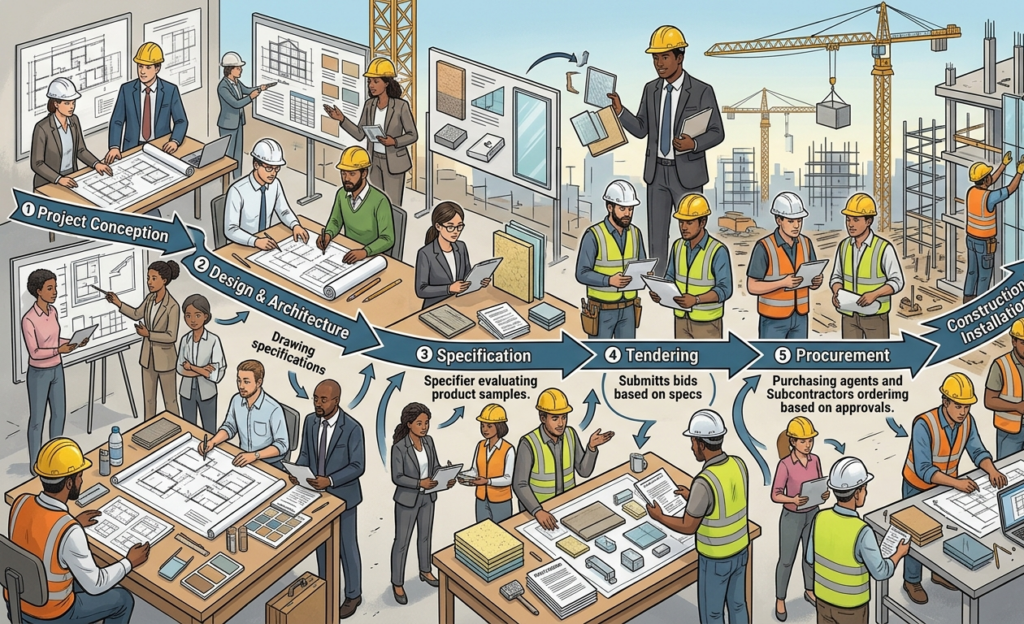
Construction doesn’t work that way. Nobody in construction buys a product the way a customer buys software or office supplies. A project comes to life, moves through design, specification, tendering, procurement, and installation, and somewhere along that journey, your product either gets chosen or it doesn’t.
And that choice isn’t made by one person. It’s made by a chain of people, each with a different role, a different priority, and a different level of influence over what ends up on site.
One project, eight people
Here’s what actually happens on a real project.
The owner kicks it off. They have the vision and the budget, and they set the tone for what matters most: cost, speed, quality, or reputation.
The architect shapes the design. Their drawings and specifications decide which products are even allowed to be considered. If your product isn’t in the spec, you’re already fighting uphill.
The consultant makes the technical calls. They check performance, compliance, and standards. One “not approved” from them can end a conversation that took months to build.
The contractor runs execution. They care about schedule, cost, and anything that could slow the site down.
The subcontractors quietly decide what actually gets installed. On paper, the spec says one thing. On site, the installer’s preference and habits often decide what goes on the wall.
The dealer or distributor controls how the product is purchased. Pricing, stock, credit terms, and relationships all run through them.
Procurement fights over price. They may never have seen the drawings, but they hold the pen on the purchase order.
And someone on site is wrestling with delivery delays every single day. If your product shows up late once, that memory shapes every decision on the next project.
Eight people. One outcome.
Now open your CRM. One account. One amount. One date.
That’s the whole story it tells you, while the real story is scattered across five inboxes, a few WhatsApp groups, some meeting notes, and someone’s memory. And the day that person quits, the deal knowledge walks out with them.
The moment it breaks
Your reps aren’t the problem. They’re on the phones, chasing approvals, visiting sites, working it every day. Effort is not what’s missing.

The problem shows up the moment leadership asks, “What’s really happening on this project?”
Now someone has to stop what they’re doing and rebuild the whole story from memory. Who’s the decision-maker? What’s the spec status? Where is the tender? Is the budget still there? Which competitor is in the room? What did the contractor say last week?
That answer takes a phone call, a few messages, and maybe a meeting. And by the time it’s assembled, it’s already a little out of date.
A CRM that needs a human translator isn’t a CRM. It’s a notebook with a login screen.
Four blind spots in most construction CRMs
If this sounds familiar, you’re not alone. When we look at how construction and building materials teams use their CRM, the same four blind spots come up again and again.
1. You find out too late
By the time you hear about a project, the architect has already specified a competitor.
This is the most expensive blind spot because it’s invisible. Nothing in your CRM tells you a project exists until someone on your team happens to hear about it, usually through a dealer, a chance conversation, or a site visit. By then, the influence window has closed.
Early in a project, you can shape the specification. You can offer technical support, share samples, and join the design conversation. Late in a project, all you can do is try to unseat a decision that’s already been made, which is a much harder and more expensive fight.

If your CRM only starts tracking a deal once there’s a quote to send, you’re joining the story in the final chapter.
2. You’re competing with yourself
One rep talks to the contractor. Another talks to the dealer. A third talks to the architect. It’s the same project, split three ways, and nobody owns the full picture.
This happens quietly. Each rep logs their own conversations against their own accounts, and each sees a small piece of the story. No one sees that three people from your own company are working the same job with three different messages, three different price expectations, and no shared plan.
The result? Mixed signals to the market, duplicate effort, and sometimes your own team undercutting each other through different channels. To a customer, it looks like your company doesn’t know what it’s doing, even though everyone on your team is working hard.
3. Your forecast is fiction
A quote went out, so the deal looks active. A date is on the calendar, so it looks real. But is the product even approved? Has the consultant signed off? Is the dealer actually stocking it? Has anyone confirmed the budget?
A quote is not a commitment.
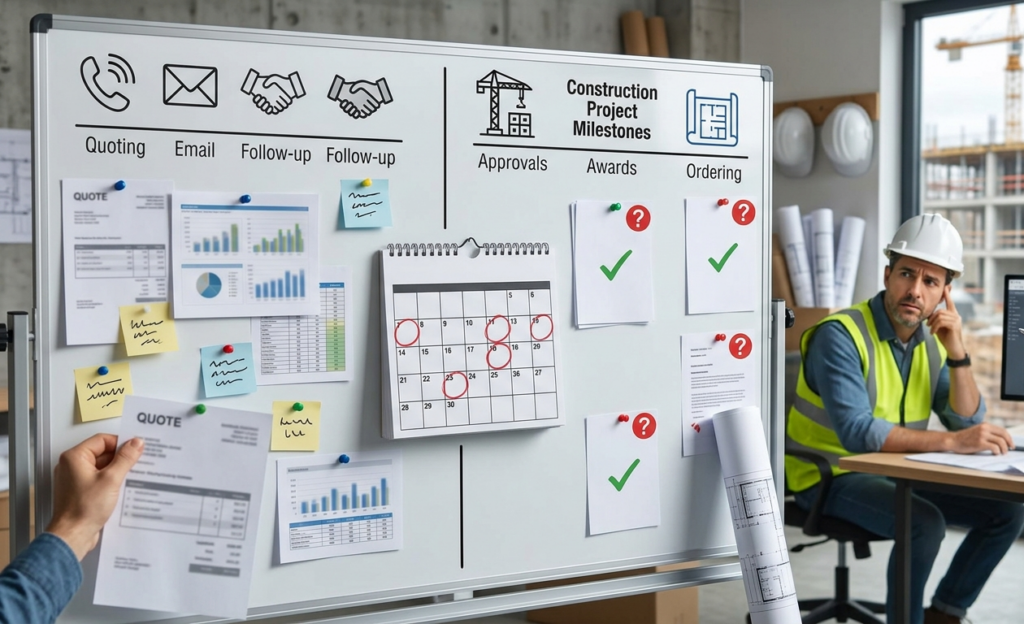
In most CRMs, pipeline stages are built around sales activity: quote sent, follow-up done, negotiation started. But in construction, what matters is project progress: spec approved, tender issued, award confirmed, order placed, delivery scheduled.
When your forecast is built on activity instead of milestones, it tells leadership what the team has been doing, not what’s likely to happen. That’s how a pipeline that looks healthy on Monday turns into a missed number at quarter-end.
4. Your CRM doesn’t move when the project does

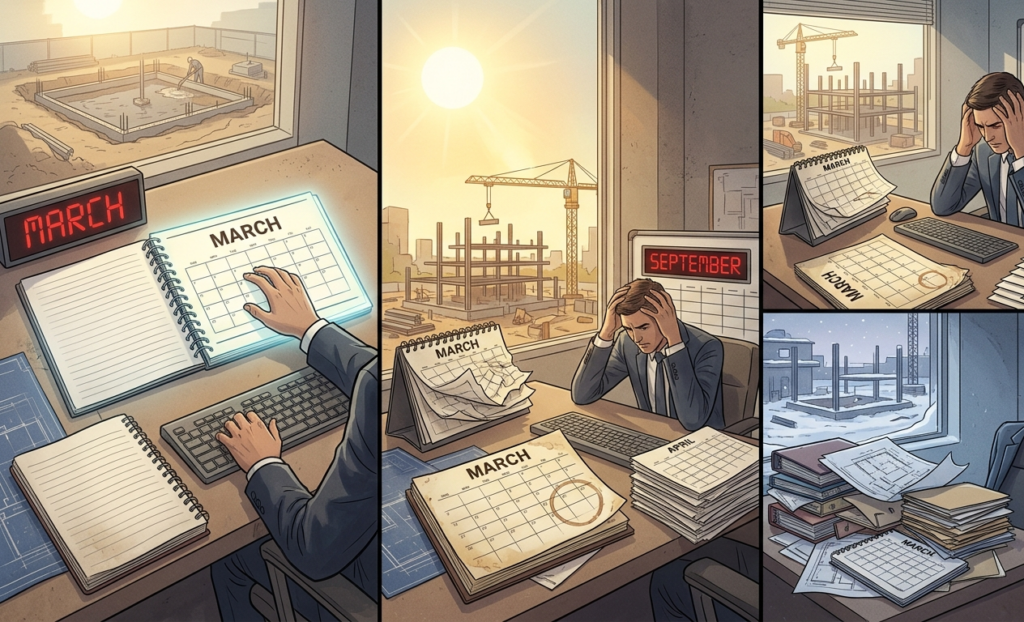
A March close quietly becomes September. Then it becomes December. And the record still says March.
Construction projects slip constantly. Approvals take longer, funding gets delayed, designs change, and sites get paused. That’s normal. What’s not normal is a CRM that doesn’t reflect it.
Because nothing updates itself, the record only changes if a rep remembers to change it. And reps are busy, so they don’t. Over time, your CRM drifts further from reality until nobody fully trusts it, and once that happens, people go back to spreadsheets and side conversations.
The real question
So here’s the question worth asking. Not “is your CRM updated?” but “does your CRM reflect reality?”
For most construction teams, the honest answer is no. And that gap isn’t a technology problem. Salesforce is more than capable. It’s a design problem.
The CRM was set up around accounts because that’s how most CRMs are set up. Nobody stopped to ask whether that matched how construction sales actually works.
How we fix it
We don’t start by asking how to fit your process into Salesforce. We ask a different question: how does a project actually move from first conversation to revenue? Then we build around that.
Here’s what that looks like in practice.
The project becomes the center
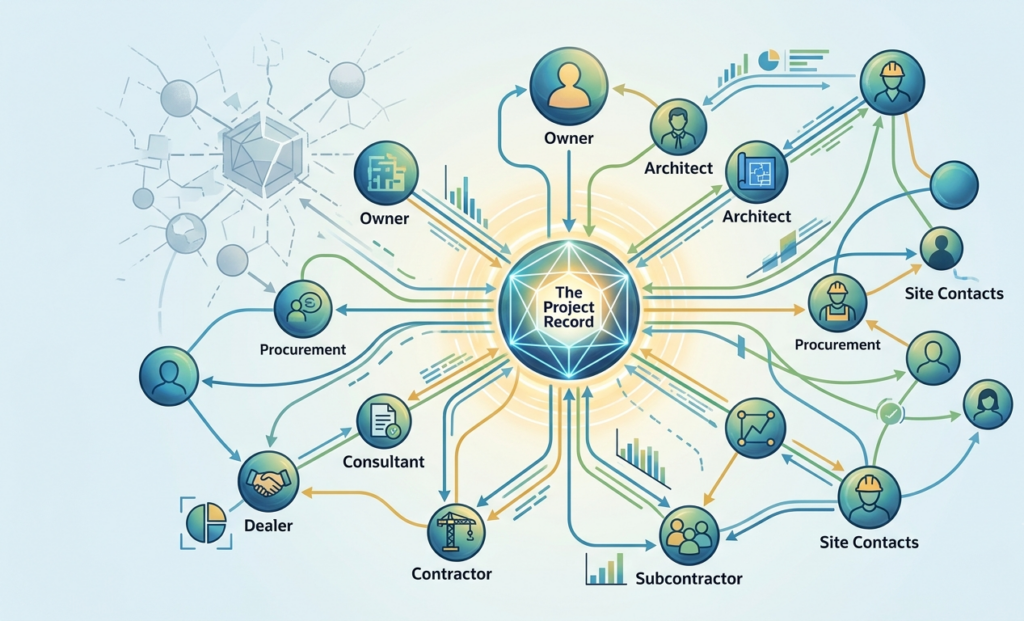
Instead of the account sitting at the middle of everything, the project does. Every project gets its own record, with its location, type, value, stage, and timeline.
Everything else connects to it: the owner, the architect, the consultant, the contractor, the subcontractors, the dealer, procurement, and site contacts. Each person is linked to the project with their role, so anyone opening the record can see instantly who’s involved and what influence they hold.
One shared picture for the whole team
When the contractor, dealer, and architect are all connected to one project record, your reps stop working in isolation. Everyone sees the same story: who’s been contacted, what was discussed, what’s pending, and who owns which relationship.
That ends the “competing with yourself” problem. It also means that when a rep leaves, the project history stays. The knowledge belongs to the company, not to one person’s inbox.

Milestones, not just stages
Instead of tracking only sales activity, we build the pipeline around the real milestones of a construction project: design stage, specification, technical approval, tender, award, order, and delivery.
Each milestone has a clear status. So when someone says “this deal is at 70%,” you can see exactly why. Is the product approved? Is the tender live? Has the award been confirmed? Your forecast stops being a guess and starts being a picture of real progress.
Quotes, technical requests, and deliveries in one place
Quotes, product approvals, technical submissions, sample requests, and delivery windows all sit on the same project record. No more searching through emails to find out whether the consultant ever replied, or whether the last delivery went out on time.
A CRM that speaks up
This is the part that changes daily life the most. A well-built system doesn’t just sit there waiting to be checked. It tells you when something needs attention:
It flags a project that has gone quiet for thirty days, so a warm opportunity doesn’t cool off unnoticed.
It warns you before a quote expires, so you can follow up while the offer is still valid.
It tells you the moment an award date slips, so your forecast adjusts the same day, not three weeks later.
Instead of relying on someone to remember, the system does the remembering.
What changes for your team
For reps, there’s less admin and more clarity. They know which projects need attention today and who else on the team is involved.
For sales managers, coaching gets easier. Instead of asking “how’s it going?” and hearing “fine,” they can open a project and see exactly where it’s stuck.
For leadership, the forecast becomes something you can trust. When someone asks, “What’s really happening on this project?”, the answer is on the screen in under thirty seconds, not buried in someone’s memory.
Where does yours break down?
Construction sales was never account-based. It’s project-based, stakeholder-driven, and milestone-dependent.
If your CRM can tell you who the customer is but not what’s happening on the project, you don’t have revenue visibility. You have a database of activity.
