
Why Your Best Customers Leave Without Complaining And What Salesforce Digital Engagement Does About It
Somewhere right now, a customer is messaging your business and no one’s answering.
Not because your team is careless. Not because they don’t care about service. It’s because the message landed in a channel nobody happened to be watching at that exact moment. And in most businesses, that’s not a rare accident. It’s a structural gap that repeats every single week, quietly, without anyone noticing until the damage is already done.
This is the story of how that gap costs businesses real revenue and the exact Salesforce feature built to close it.

The Shift Businesses Never Fully Adjusted To
Ten years ago, a customer had two ways to reach you: phone or email. Today, they have five or six WhatsApp, live chat on your website, SMS, Facebook Messenger, Apple Business Chat, and email, all in active use, often by the same customer depending on what’s convenient in the moment.

The result: each channel is typically monitored by a different tool, and often a different person. A rep watching live chat has no visibility into WhatsApp. Whoever checks the shared email inbox has no idea a customer already asked the same question over text an hour earlier. Every channel becomes its own island, and the customer is the only one who can see the whole conversation because they’re the one who had it, in pieces, across every platform your business uses.
What This Actually Looks Like in Practice
Consider a mid-sized building materials distributor supplying cement and structural steel to around 60 regional dealers. In this kind of business, a delayed delivery isn’t a minor inconvenience it means a construction crew of twenty people standing around a job site with nothing to pour.
One Monday morning, a dealer who had ordered from this distributor for six years sent a WhatsApp message asking if that day’s shipment was still on schedule. The rep who normally monitored WhatsApp was out sick. Nobody had been told to cover the channel. The message sat there, unread.
An hour later, he followed up a little more urgency this time. Still nothing, because it was landing in the same unmonitored inbox. Two hours in, he gave up on WhatsApp and tried the website’s live chat instead. A completely different rep picked it up, with zero visibility into the WhatsApp conversation. She asked him to repeat the order number and delivery date everything he’d already explained an hour earlier.

He was now explaining the same problem for the third time, to the third different person, while his crew sat idle and his own costs climbed by the hour.
By 1 PM, he was done waiting. He called a competitor, confirmed they had stock, and placed the order there instead same-day delivery, no back-and-forth.
The Part That Makes This Expensive: He Never Complained
This is the detail that makes fragmented communication such a dangerous, invisible cost. The dealer didn’t escalate. He didn’t file a complaint. He simply started ordering less from this distributor going forward a slightly smaller order here, a slightly longer gap between orders there.

Six months later, when someone finally reviewed dealer activity, his order volume had dropped by almost 40 percent. Nobody had connected it to that one Monday morning. It wasn’t a single lost order it was the slow, silent erosion of a six-year relationship. And when they looked closer, the same pattern was showing up with other dealers too. It had just never been visible until someone went looking for it.
This is why fragmented communication is so much more expensive than it appears on a service dashboard. Angry customers show up in complaint logs. Quiet customers don’t show up anywhere until the revenue number does.
The Real Problem Was Never Effort
It’s tempting to read a story like this and assume the team wasn’t working hard enough. That’s rarely the case. The reps in this story were doing their jobs checking their assigned channel, responding when they saw a message. The problem was structural: four channels meant four blind spots, and no single person or system had a full picture of any one customer’s conversation.
This is exactly the gap that Salesforce’s Digital Engagement feature is built to close.
What Salesforce Digital Engagement Actually Is
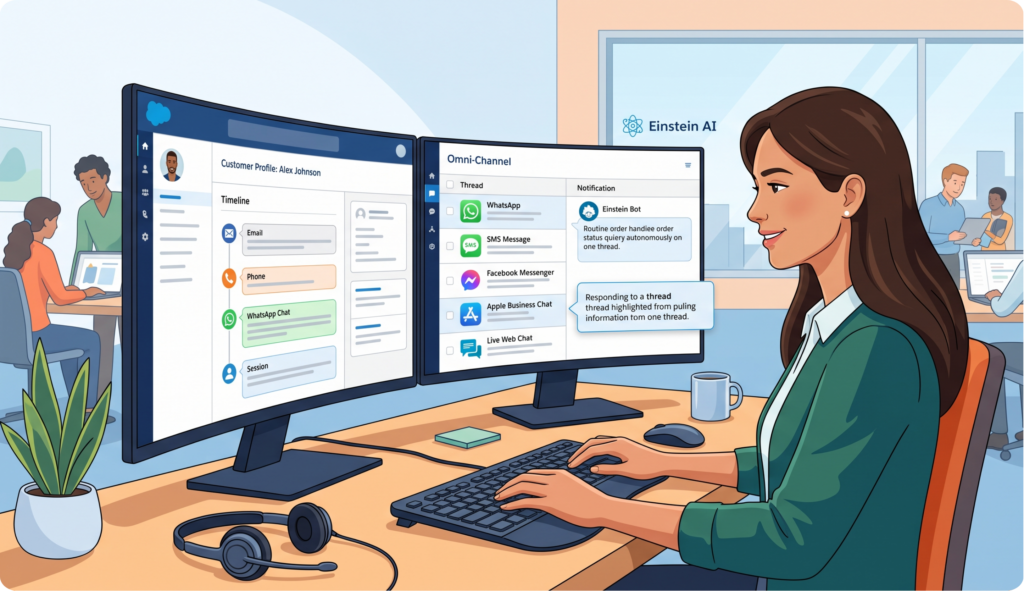
Digital Engagement is a Service Cloud capability that connects every customer messaging channel, WhatsApp, SMS, Facebook Messenger, Apple Business Chat, web chat, and in-app chat into a single console, the same one your service reps already woiirk from every day. It’s not a new platform your team has to learn. It’s the elimination of the five separate platforms they were already juggling.
Here’s what changes in practice:
1. Unified channels, one queue. No matter which app a customer uses to reach out, the message lands in the same place your team already monitors. A WhatsApp message and a live chat message from two different customers now sit in the same queue, visible to whoever is working it instead of requiring a rep to be logged into five separate tools simultaneously.
2. Einstein Bots handle the routine questions automatically. Delivery status, order confirmations, appointment reminders these don’t need to wait for a human to be available. Bots respond instantly, at any hour, and only escalate to a rep when something genuinely needs a person’s judgment. This alone removes the majority of the volume that causes response-time bottlenecks in the first place.
3. Every conversation attaches to the customer’s record. This is the detail that solves the explaining it for the third time problem. If a rep picks up a conversation that started on a different channel, they see the entire history immediately no guessing, no asking the customer to repeat themselves, no starting from zero.
The Measurable Difference
When this distributor put Digital Engagement in place, the change wasn’t incremental it was structural. Response time on delivery questions dropped from roughly four hours to under six minutes. Complaints about no response fell by more than half. Reps stopped juggling four separate logins and started working out of a single, unified queue.
And the dealer who had switched to a competitor? He came back three months later not because of a sales pitch, but because the next time he messaged, someone answered in under a minute.
The Takeaway
This was never a service quality problem. The team cared, and they were working hard. It was a visibility problem messages scattered across five different places, with no one able to see the full picture of a single conversation in one spot.
If your team is currently managing customer conversations across WhatsApp, SMS, live chat, and email as five separate systems, that fragmentation is very likely costing you customers who will never tell you why they left. The good news: if you’re already running Salesforce Service Cloud, closing this gap isn’t a six-month overhaul. It’s configuration, not reinvention. At Titanium Tekzi, we help businesses implement and optimize Salesforce solutions like Digital Engagement turning fragmented, multi-channel support into one connected system that responds faster and retains more customers.
If your team is spread across too many tools to answer one customer consistently, that’s the gap worth closing first.
